Industrial Solar Power Systems: A Complete Guide for Nigerian Industries
Industrial Solar Power Systems: A Complete Guide for Nigerian Industries
Nigeria’s industrial sector depends heavily on reliable electricity to power manufacturing equipment, production lines, refrigeration systems, water treatment facilities, warehouses and other critical operations. However, rising energy costs, grid instability and dependence on diesel generators are putting increasing pressure on businesses.
Industrial solar power systems provide a practical way for Nigerian industries to reduce energy costs, improve power reliability and build more sustainable operations. By combining solar panels, high-capacity inverters, battery energy storage and intelligent energy management, businesses can generate and manage a significant portion of their electricity requirements.

What Is an Industrial Solar Power System?
An industrial solar power system is a large scale solar energy solution designed to meet the electricity demands of factories, production facilities, warehouses, hospitals, commercial buildings and other high energy users.
Unlike small residential solar installations, industrial solar systems are engineered around the customer's actual energy consumption, operating hours, critical loads, available roof or land space and backup requirements.
Why Nigerian Industries Are Switching to Solar Energy
For many Nigerian businesses, electricity is a major operating expense. Industries often rely on a combination of grid electricity and diesel generators to maintain production. Solar energy can reduce this dependence by supplying clean electricity during daylight hours while battery storage can provide energy when solar generation is unavailable.
1. Reduced Energy Costs
Industrial solar power can reduce the amount of electricity purchased from the grid and the amount of diesel consumed by generators. Over the operational life of a properly designed system, these savings can significantly improve energy cost management.
2. Lower Diesel Consumption
Integrating solar with battery storage can reduce generator runtime and therefore lower diesel consumption, maintenance requirements and generator operating costs.
3. Improved Power Reliability
A properly engineered commercial and industrial solar system can provide an additional source of electricity when grid power is unavailable. Battery storage can also support critical loads during power interruptions.
4. Greater Energy Independence
Rather than depending entirely on the grid or generators, businesses can generate part of their electricity on-site. This creates a more diversified and resilient energy supply.
5. Sustainable Business Operations
Solar power produces electricity without the direct combustion emissions associated with diesel generation. For companies pursuing sustainability and ESG objectives, industrial solar energy can support their environmental goals.
How Industrial Solar Power Systems Work
During daylight hours, solar panels convert sunlight into DC electricity. The inverter converts this electricity into usable AC power for industrial equipment.
Depending on the system design, excess energy can be stored in batteries for later use. The system can also coordinate available power from solar, batteries, the grid and generators.
This creates an integrated industrial energy management system that determines how available power is supplied to the facility.
Key Components of an Industrial Solar Installation
Solar Panels
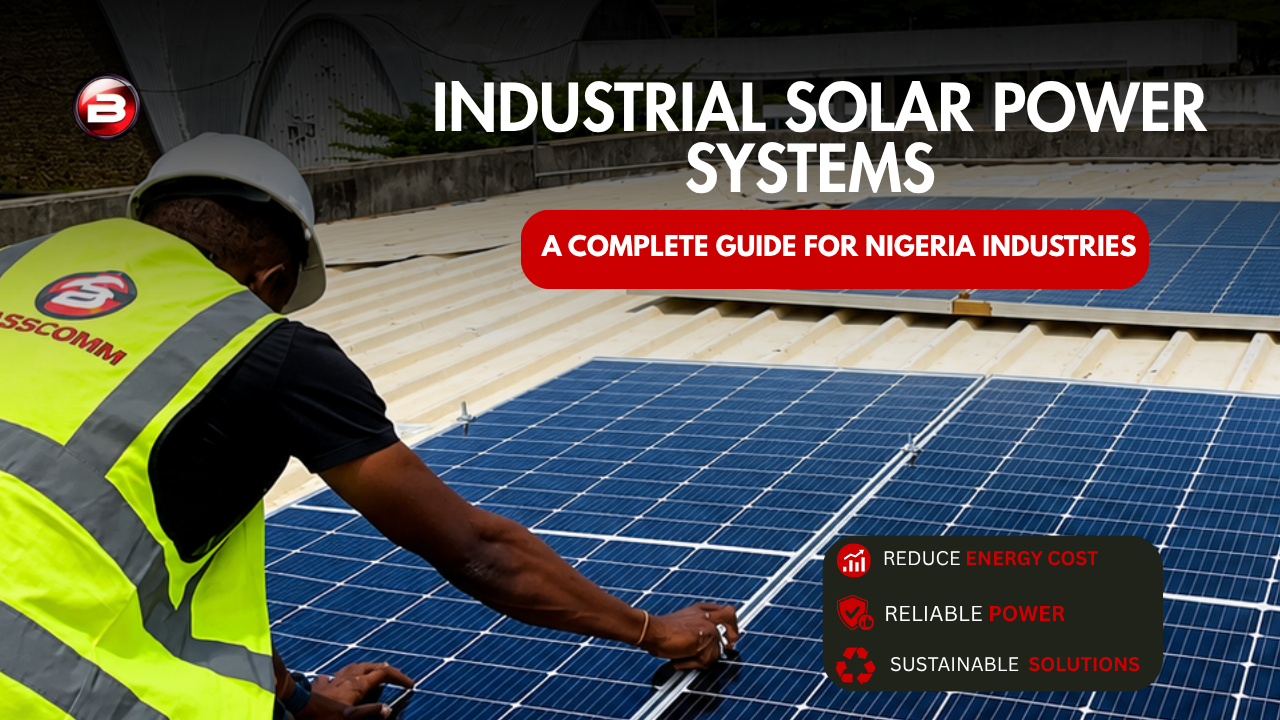
Solar panels convert sunlight into electrical energy. For industrial projects, panel selection should consider efficiency, durability, available installation space and expected operating conditions.
Solar Inverters
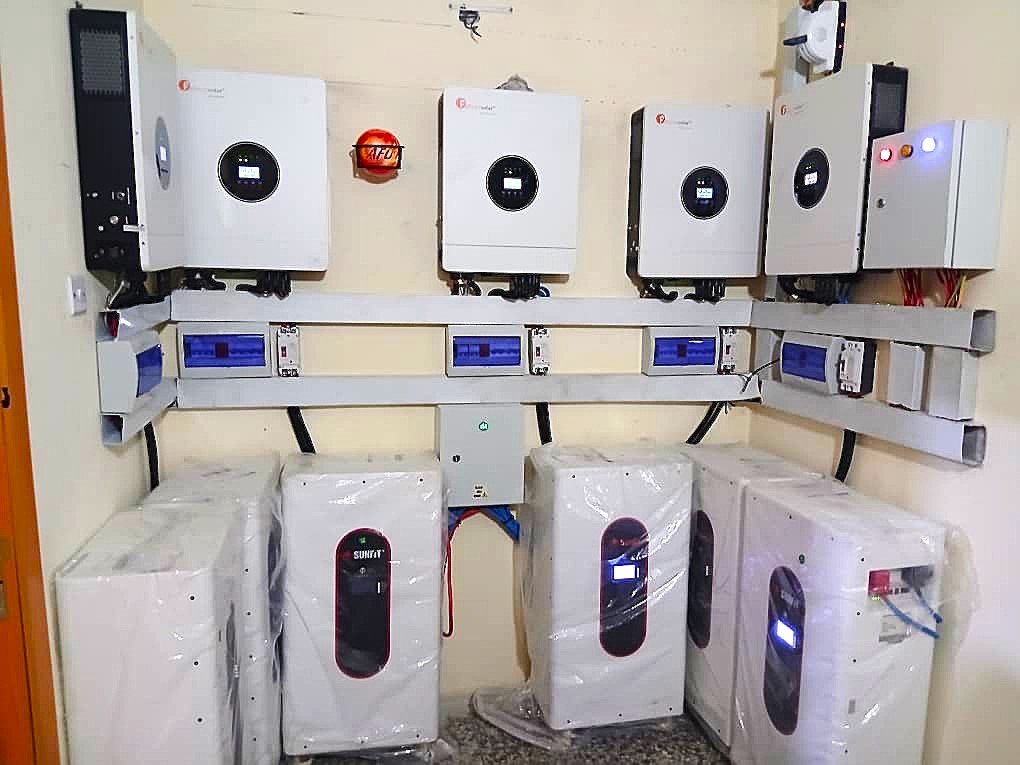
Industrial solar inverters convert DC electricity from the panels into AC electricity used by industrial equipment. The inverter is also responsible for managing different power sources in many hybrid systems.
Battery Energy Storage
Battery storage allows businesses to store solar energy and use it when required. Lithium-ion batteries are increasingly used for commercial and industrial energy storage because of their performance and energy density.
Mounting Structures
Mounting systems securely position solar panels on rooftops, car parks or ground-mounted structures while allowing the panels to capture available sunlight efficiently.
Monitoring and Energy Management
Modern solar systems can include monitoring platforms that provide information about solar generation, battery status, energy consumption and system performance.
Industries That Can Benefit From Solar Power
Manufacturing: Production facilities can use solar power to reduce electricity costs and support critical production processes.
Healthcare: Hospitals and medical facilities can use solar and battery storage to support essential electrical loads.
Warehousing and Logistics: Large warehouses can take advantage of expansive rooftops for solar installation.
Water Treatment: Solar energy can help power pumps, control systems and other electrical equipment used in water treatment facilities.
Hotels and Commercial Buildings: Solar can support lighting, cooling, security systems, elevators and other building services.
Agriculture and Food Processing: Processing plants, cold rooms and agricultural facilities can use solar power to reduce dependence on diesel generation.
Industrial Solar vs Diesel Generators
Diesel generators can provide dependable backup power, but they require continuous fuel purchases, routine servicing and maintenance. Fuel price increases can also significantly affect operating costs.
Industrial solar systems have higher upfront installation costs but generally have lower ongoing energy-generation costs because sunlight is free.
For many facilities, the most practical solution is not necessarily to eliminate generators completely. Instead, solar, battery storage, grid electricity and generators can be integrated into a hybrid power system that prioritizes the most economical and available energy source.
Industrial Solar Installation Process
A professional industrial solar installation typically begins with an assessment of the facility's energy requirements.
1. Energy audit and load assessment
2. Site inspection
3. Solar resource and installation assessment
4. System design and engineering
5. Financial and return on investment analysis
6. Equipment selection
7. Installation and electrical integration
8. Testing and commissioning
9. Monitoring and performance evaluation
10. Ongoing maintenance and support
The Future of Industrial Solar Energy in Nigeria
As businesses continue to search for more predictable and cost effective energy solutions, industrial solar power systems in Nigeria are becoming an increasingly important part of energy planning.
The combination of solar photovoltaic technology, battery energy storage, smart monitoring and hybrid power management is creating new opportunities for businesses to reduce energy costs while improving operational resilience.
For Nigerian industries, solar is no longer simply an alternative energy source. When properly engineered, it can become an important component of a long-term commercial and industrial energy strategy.
Industrial solar power systems offer Nigerian businesses an opportunity to reduce energy costs, lower diesel consumption, improve power reliability and support sustainability goals.
The key to achieving these benefits is proper engineering. Rather than simply purchasing solar panels, businesses should invest in a complete energy solution designed around their specific electrical loads, operational requirements and financial objectives.
For companies considering commercial and industrial solar solutions in Nigeria, the right starting point is a professional energy assessment and feasibility study.
Contact Basscomm Nigeria Limited to discuss a customized solar solution for your commercial property, or industrial facility.
Email:Crm@ basscommgroup.com Tel +2349138452783